The Science Behind the Shot
GLP-1s Aren’t New. They’re Just Finally Understood.
Forty years of research came before the prescription. Here is where GLP-1 medications actually came from, and what long-term data shows about them.
Something felt off for a lot of patients before GLP-1s ever had a brand name. Blood sugar that would not settle. Weight that would not move no matter what got cut from a plate. The medications getting attention now are not a shortcut someone invented last year. They are the result of decades of endocrine research, and the long-term data behind them is some of the strongest in modern medicine.
A Discovery No One Expected
A Hormone That Disappeared Too Fast
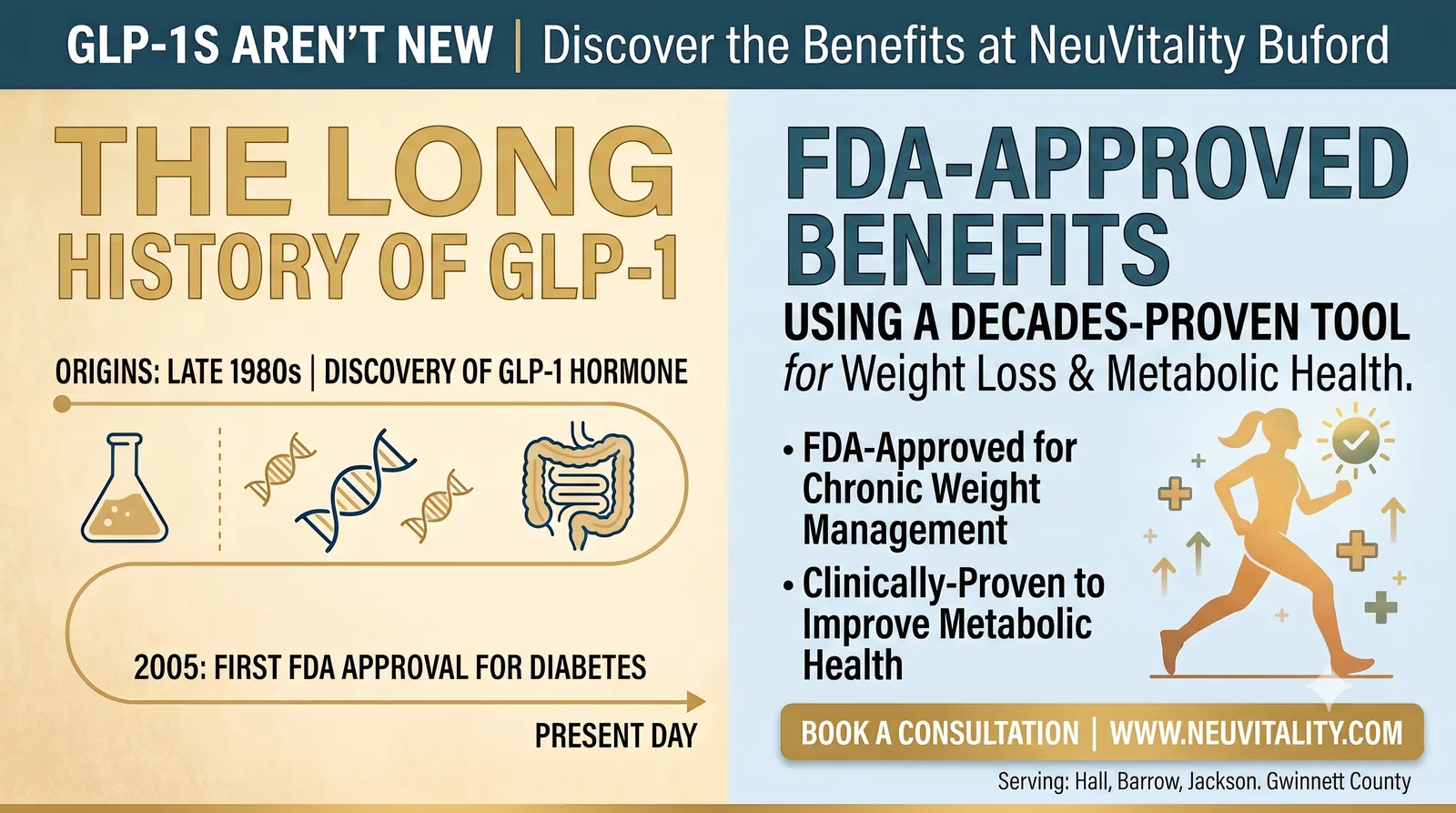
In the 1980s, researchers studying digestion noticed something. A hormone released from the gut after eating triggered the body to release insulin. They called it GLP-1. It worked. The problem was timing. The body broke it down within minutes, long before it could be turned into a treatment (History Cooperative).
The Answer Came From a Lizard
The breakthrough did not come from a lab. It came from the Southwest desert. In 1992, researcher John Eng found a compound in Gila monster venom that acted like GLP-1, but resisted the enzyme that broke the human version down. It lasted hours instead of minutes (Fella Health). That compound became exenatide, approved by the FDA in 2005 as the first drug of its kind. Every GLP-1 medication since, including semaglutide and tirzepatide, built on that same discovery (IntuitionLabs).
1992 · The Origin Story
The compound came from venom.
The science came after.
Gila monster venom held the compound that became the first GLP-1 medication. Every GLP-1 therapy since traces back to this discovery.
Four Decades Later, the Proof Is In
A Trial That Changed Cardiology
The SELECT trial followed more than 17,000 adults with heart disease and excess weight, without diabetes, for close to four years. It was published in the New England Journal of Medicine. Semaglutide reduced major cardiovascular events, including heart attack and stroke, by 20 percent compared to placebo (NEJM, SELECT Trial).
20% reduction in major cardiovascular events (SELECT trial)
73% lower progression to type 2 diabetes
4 yrs of sustained results tracked in follow-up data
Results That Hold Up Over Years, Not Weeks
Follow-up data from SELECT showed weight loss held for up to four years, alongside a 73 percent reduction in progression to type 2 diabetes and a 22 percent lower risk of kidney-related outcomes (PMC, SELECT Kidney Outcomes). Separate three-year data on tirzepatide showed the same pattern: sustained weight reduction and a markedly lower risk of developing diabetes compared to placebo (NEJM, Tirzepatide Diabetes Prevention).
The research is also clear about what happens without ongoing care. Studies following patients after they stop treatment show weight and metabolic markers can reverse. That is why this only works as part of a supervised, ongoing plan, not a one-time prescription (Life Metabolism, Oxford Academic).
Try It Yourself
Where Will I Be?
Enter your numbers. See where the next year could take you.
Height (ft)
Height (in)
Current Weight (lbs)
Program
Semaglutide Tirzepatide
Sex (Optional)
Combined Average Female Male
Trial data shows women and men respond differently on average. Pick one for a closer estimate, or leave it on the combined average.
Where Will I Be?
Enter your height and current weight to see a projection.
Where You’re Headed
How this works. This is a model, not a guarantee. It’s built on real trial data: STEP 1 for semaglutide, SURMOUNT-1 for tirzepatide, both published in the New England Journal of Medicine.
Averages describe a trial population. They don’t describe you. Your result depends on your dose, your consistency, and your body.
This tool is for information only. It is not medical advice. Your NeuVitality Buford provider builds your actual plan around your health, not an average.
What This Means at NeuVitality Buford
This is not about aging, and it is not about a number on a scale. It is about understanding what your body is actually doing, and having a provider who explains it in plain language. Our medical weight loss program is physician-guided from the first visit. Labs, nutrition support, and ongoing adjustments are part of the plan, not an upsell.
Individual results vary, and any GLP-1 program should be guided by a licensed provider who reviews your full health history.
Ready for an honest conversation about whether GLP-1 therapy fits your health?
References
- History Cooperative. “A Brief History of GLP-1 Agonists: From Discovery to Modern.” historycooperative.org
- Fella Health. “What Is GLP-1 Lizard Venom: Gila Monster Discovery to Diabetes Drugs.” fellahealth.com
- IntuitionLabs. “GLP-1 Drugs: A Complete History of Incretin-Based Therapy.” intuitionlabs.ai
- Lincoff, A.M., et al. “Semaglutide and Cardiovascular Outcomes in Obesity without Diabetes” (SELECT Trial). New England Journal of Medicine, 2023. nejm.org
- “Long-term kidney outcomes of semaglutide in obesity and cardiovascular disease in the SELECT trial.” PMC
- Wilding, J.P.H., et al. “Once-Weekly Semaglutide in Adults with Overweight or Obesity” (STEP 1 Trial). New England Journal of Medicine, 2021. nejm.org
- Jastreboff, A.M., et al. “Tirzepatide Once Weekly for the Treatment of Obesity” (SURMOUNT-1 Trial). New England Journal of Medicine, 2022. nejm.org
- “Tirzepatide for Obesity Treatment and Diabetes Prevention.” New England Journal of Medicine. nejm.org
- “Weight loss maintenance after tirzepatide cessation in people with overweight/obesity.” Life Metabolism, Oxford Academic. academic.oup.com
- García, L-E., et al. “Tirzepatide associated with greater weight loss in women than men” (pooled post hoc analysis of the SURMOUNT trials). Diabetologia / EASD 2024. eurekalert.org
- Medscape. “Women Tend to Lose More Weight Than Men With Weight-Loss Drugs” (STEP 1 sex subgroup analysis). medscape.com
Content is for informational purposes only and does not constitute medical advice. Individual results vary. Consult a qualified provider before starting any treatment.